
Reviewed · MOROCCO · TOURS IN MARRAKECH
Marrakech: Bahia Palace, Saadian Tombs & Top Highlights Tour
The most rewarding part of this Marrakech tour is the way it links grand monuments with ordinary Medina life. In four hours, you move from the Almohad minaret of Koutoubia to royal tombs, palace courtyards, the old Jewish quarter, and workshops where craftspeople still work by hand. It gives you a useful first map of the old city.
I like the strong mix of architecture and local context, especially the explanation of the Mellah and its former Jewish community. I also like the guide-led walk through the souks, where you can ask about spices, textiles, metalwork, and prices instead of wandering without a clue. The main drawback is crowding: Bahia Palace can be busy, and the small viewing area at the Saadian Tombs may involve a wait.
Key points at a glance
- Four hours on foot: The route covers major sights in the Medina without trying to squeeze in the entire city.
- Koutoubia from the outside: You see Marrakech’s signature 12th-century minaret, but the mosque visit is exterior only.
- Bahia Palace takes the most time: Allow about 90 minutes for carved cedar, tiled courtyards, and palace history.
- The Saadian Tombs are compact: The royal burial site is beautiful but can create a line at its best-known chamber.
- Mellah adds important context: You learn about Jewish life in the old city, though the Jewish Square itself is not included as an admission visit.
- Ticket choice matters: At $15, the basic price is appealing, but monument entry fees are separate unless you select the shared tour with tickets.
A useful first walk through Marrakech’s old city
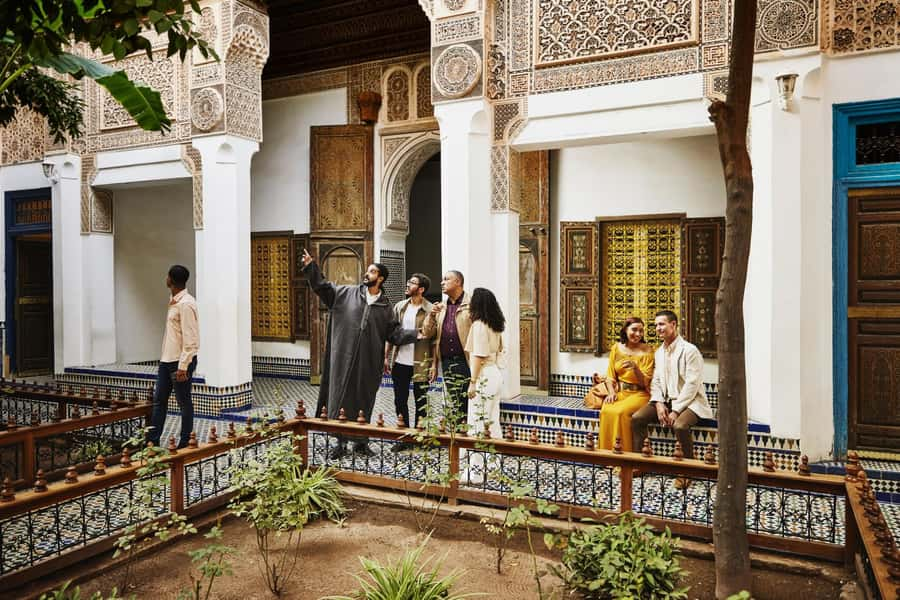
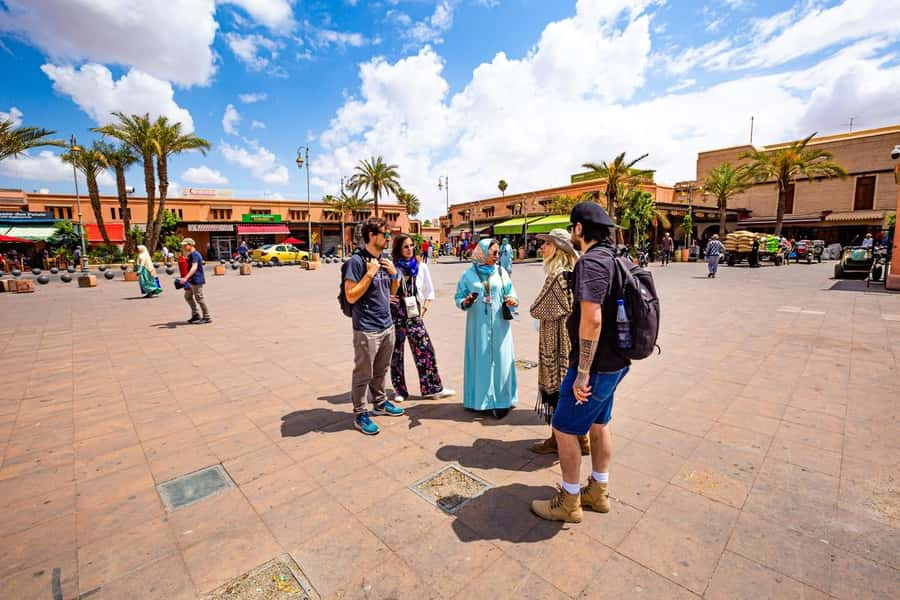
This is a compact introduction to Marrakech rather than a relaxed visit to one or two monuments. You meet your guide in front of Café Argana in Jemaa el-Fna Square, then set off through streets where major landmarks and daily commerce sit close together.
The exact starting point depends on the option you book. If you choose the private tour with Medina pickup, the guide can meet you at your hotel or riad if it is inside the Medina. Otherwise, Café Argana is the fixed meeting point. A WhatsApp message with the guide’s name and meeting details is sent the day before, which is useful in a city where finding the right doorway can take patience.
The walk lasts about four hours. You should expect steady movement, short stops, and some free time at the monuments and souks. The group may wait five to ten minutes for late arrivals, but anyone more than 15 minutes late is treated as a no-show. Bring cash, sunglasses, and water. Mineral water is not supplied.
Guides speak Arabic, English, French, and Italian. Names reported for this experience include Ahmed and Zakaria. Ahmed was singled out for keeping the visit on time and interesting, while Zakaria was praised for explaining culture, religion, architecture, and dynasties. Those details matter because this tour depends heavily on the guide. The buildings are impressive on their own, but a good explanation helps you understand what you are seeing.
Other palaces and gardens to see in Marrakesh:
- Marrakesh: Majorelle Garden Entry Tickets
★ 4.5 · 9,651 reviews - Marrakech: Majorelle Garden, YSL, and Berber Museum Entry
★ 4.6 · 5,168 reviews - Marrakech: Bahia Palace, Saadian Tombs, Souk and Medina Tour
★ 4.7 · 4,974 reviews
Koutoubia Mosque and the Almohad signature
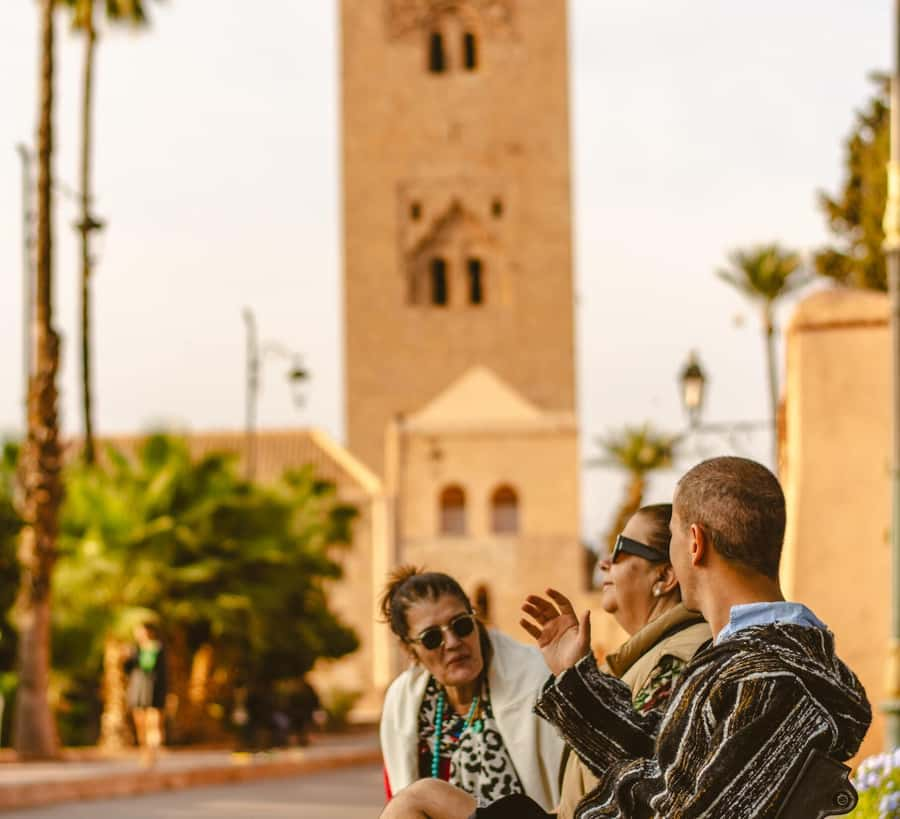
Your first major sight is Koutoubia Mosque, usually viewed from outside. Its 12th-century minaret is Marrakech’s most recognizable landmark, with a clean, restrained style linked to the Almohad period.
The stop is short, about ten minutes in the stated schedule. That is enough for photographs and an introduction to the mosque’s place in the city, but not enough for a long architectural study. Non-Muslim visitors should also note that this is an exterior visit. The tour does not offer entry into the mosque.
Koutoubia works well as an opening stop because it gives you a fixed point before the streets become more confusing. Look up at the proportions of the minaret, then notice how often it appears as you move around Marrakech. Your guide can also place the city’s later palaces and dynasties against this earlier Almohad landmark.
Bahia Palace and its patient details
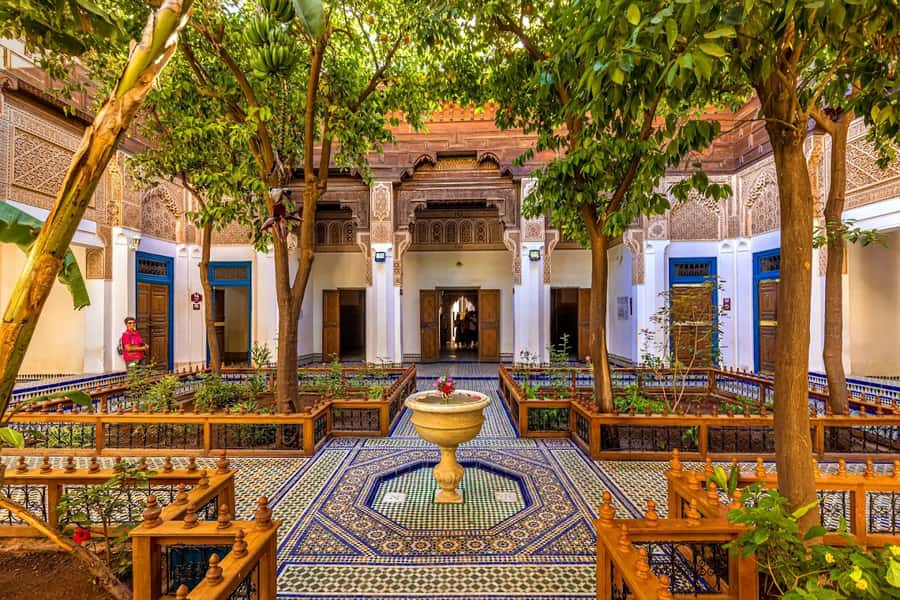
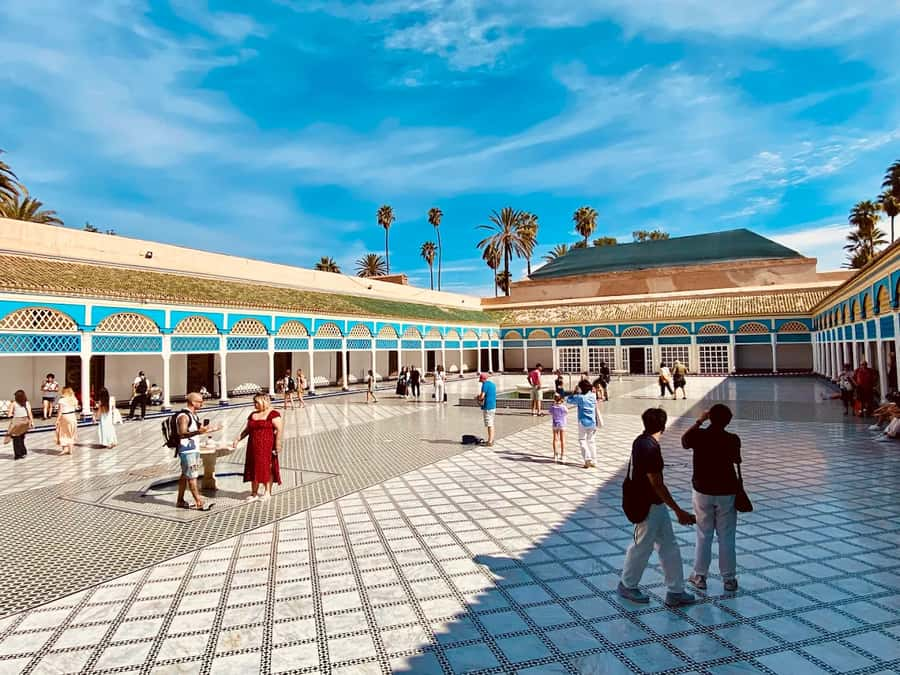
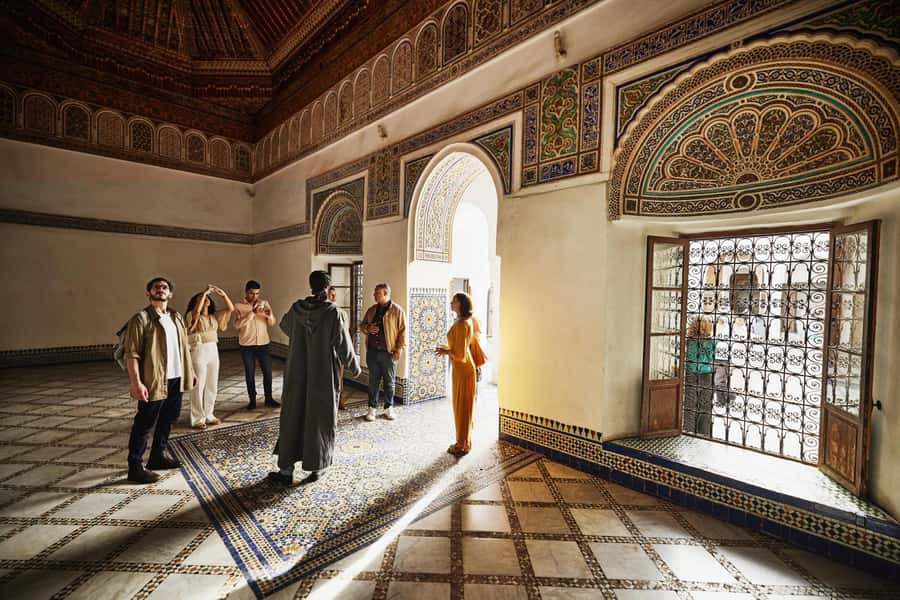
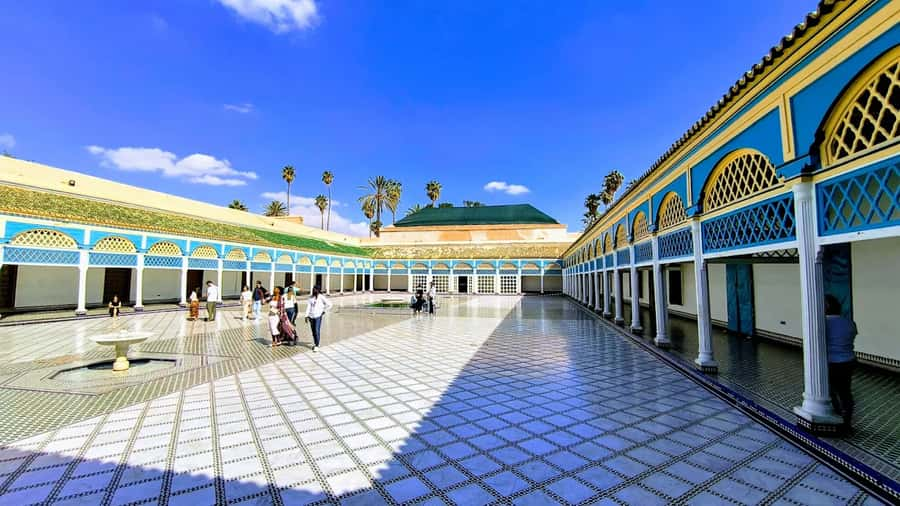
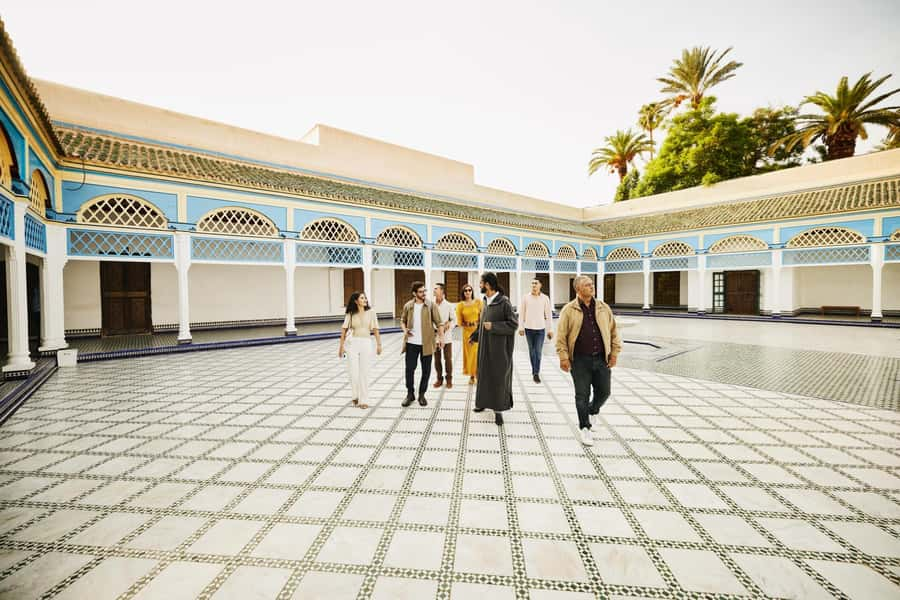
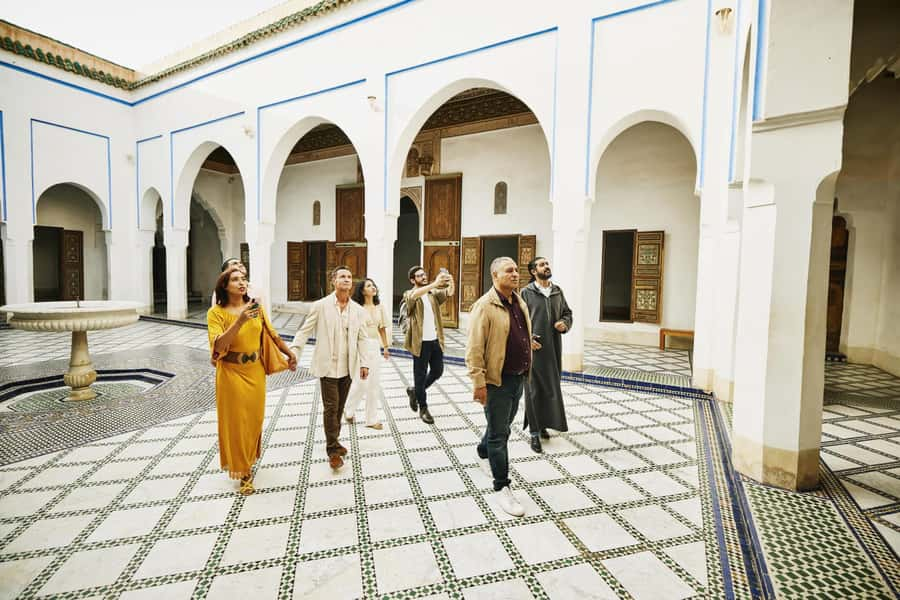
Bahia Palace receives the longest stop, about an hour and a half. That makes sense. This is the tour’s richest architectural visit, with carved cedar ceilings, mosaic tilework, courtyards, and rooms built around private palace life.
Do not rush through the tiled floors. Moroccan zellij is made from small cut pieces arranged into repeating geometric designs, and the effect changes as you walk across the courtyard. Look above you as well, since the cedar ceilings can carry as much visual interest as the walls.
The palace is not a single grand hall in the European sense. Its appeal comes from the sequence of spaces, intimate rooms, shaded courtyards, and ornamental surfaces. Your guide helps explain how the building worked and why its decoration matters. Without that context, you may simply see a series of pretty rooms and move on.
Crowds are the main concern. One recent visit described heavy foot traffic and queues, particularly at popular areas. The guide’s humor and calm attitude helped make the wait easier, but you should still expect the palace to feel busy at certain times. If you dislike crowded interiors, this is the part of the tour most likely to test your patience.
The Mellah and Marrakech’s Jewish past
The Mellah adds a side of Marrakech that many quick city walks miss. This was the old Jewish quarter, with its own community, religious life, and architectural character within the Medina.
The tour includes guided explanation and a short visit or photo stop in the area. It does not include a separate admission visit to the Jewish Square itself, so check your expectations before booking. The value here is the story. You learn how a Jewish community once lived and worked in Marrakech, and how that past remains part of the old city’s identity.
The route description places the Mellah between Bahia Palace and the Saadian Tombs, with some time later in the area for shopping and sightseeing. Since walking routes can shift with crowds and local conditions, the exact order may vary. You should think of this as a guided look at the quarter rather than a long, independent exploration.
I especially like this section for visitors who want more than palace decoration. It gives the Medina a human dimension and shows that Marrakech’s history includes different communities, faiths, and ways of life.
Same base, a different sort of day:
- Marrakech: Agafay Desert Sunset, Camel Ride, and Dinner Show
★ 4.6 · 35,119 reviews - From Marrakech: Ouzoud Waterfalls Guided Hike and Boat Trip
★ 4.7 · 33,630 reviews - Marrakech: Agafay Desert Quad & Camel Rides with Dinner Show
★ 4.8 · 27,382 reviews - Marrakech: Agafay Desert Quad Biking Tour with Dinner-Show
★ 4.8 · 16,569 reviews
Saadian Tombs and the cost of a beautiful bottleneck
The Saadian Tombs are a 16th-century royal burial site, known for marble, carved surfaces, and detailed tilework. The visit lasts about 30 minutes, so the guide’s explanation is important. You will have time to see the main features and take photographs, but this is not a slow, private visit.
The best-known chamber is also the part most likely to create a queue. The tombs are compact, and everyone naturally gathers at the same richly decorated viewpoint. One practical advantage of joining a guide is that you receive historical context while waiting instead of simply standing in line.
The stop is worth keeping on your list, but set realistic expectations. You are not entering a huge complex where you can wander for an hour. You are seeing a small, carefully decorated royal mausoleum, then moving on. The contrast with Bahia Palace is part of the appeal: Bahia spreads you through courtyards and rooms, while the tombs concentrate attention on burial architecture and decoration.
Bab Agnaou and Tinsmiths Square
The walk also passes Bab Agnaou, one of Marrakech’s notable historic gates. The schedule allows for a photo stop, a short guided explanation, and walking rather than a long formal visit.
Bab Agnaou is useful as a reminder that the Medina was designed with thresholds and defenses, not just markets and palaces. You will not spend a large portion of the tour here, but the gate gives you another view of the city’s older urban design.
Tinsmiths Square receives another short stop of around ten minutes. This area connects the tour to working craft traditions and the metalwork side of the Medina. You may see workshops and goods being made or sold, though the exact activity can vary.
These brief stops work best when you treat them as links between the major monuments. They break up the palace and tomb visits and help you notice how the old city functions beyond its famous sights.
Souks, workshops, and the practical value of a guide
The final stretch takes you through colorful souks and artisan workshops. You may encounter spices, textiles, metal goods, and local crafts, with the guide explaining what you are looking at and where traditional skills are practiced.
This is the point where a guide can save you time and confusion. The souks are not arranged like a modern shopping street, and it is easy to lose your bearings. You can ask questions about materials, workmanship, and local customs before deciding if you want to buy anything.
The tour includes shopping time, but it is not a dedicated shopping excursion. You should not expect a long, unhurried session at every stall. Instead, you get a guided introduction, followed by a chance to browse and make your own choices.
If you want to purchase something, bring cash. The activity information specifically advises carrying it, and entrance fees for the monuments must also be paid in Moroccan dirhams when your selected option does not include tickets. Keep the shopping portion flexible. The goal is to see how the souks work, not to fill your suitcase at every stop.
Is $15 good value?
At $15 per person, the base price is attractive for a four-hour guided walk covering several major sights. You are paying mainly for the guide, organization, and local explanation. For a first day in Marrakech, that can be a sensible use of money.
The important detail is the ticket option. Monument entry is not included in the standard version unless you select the Small Group Shared Tour with Tickets. You can also choose a Private Tour and Medina Pickup option, or a Small Group Shared Tour without tickets. Read the option name carefully before paying, since the cheapest price may not be the final cost once admission fees are added.
The included-ticket option is more convenient because it removes the need to buy tickets during the walk and may provide skip-the-line entry. The exact financial advantage depends on the monument fees and the price difference at booking. A private group costs more, but it gives you a more personal pace and makes sense for families or friends who want to ask many questions.
For a short city orientation, the value is strong. For a quiet architectural study, the tour may feel rushed, especially at the tombs and during crowded periods at Bahia Palace.
Who will enjoy this four-hour walk?
I would recommend it to a first-time visitor who wants the main historic sights explained in one session. It also suits anyone who prefers walking to arranging separate taxis, tickets, and guides for each monument.
Families can benefit from the variety. A mosque exterior, palace rooms, tombs, city gates, a former Jewish quarter, and souks provide enough change to keep the walk moving. Ahmed’s reported ability to keep the schedule and make the explanations interesting is particularly relevant for a family group.
This is also a good choice if you want cultural context, not just photographs. Zakaria’s reported explanations of religion, architecture, dynasties, and Moroccan culture point to the sort of broad overview the tour aims to provide.
You may want another plan if you have limited walking ability, dislike crowds, or want to spend a full afternoon at Bahia Palace alone. The activity is listed as wheelchair accessible, but the Medina’s busy streets and the amount of walking still make it sensible to confirm your needs before booking.
Free cancellation is available up to 24 hours before the start, and you can reserve now and pay later. Those policies help if your Marrakech schedule is still changing, but they do not solve the need to arrive at the meeting point on time.
Should you book it?
Book this tour if you want an affordable, guided introduction to Marrakech’s central monuments and Medina culture. The strongest reasons are the range of stops, the focus on the Mellah, and the chance to explore the souks with someone who can explain what you are seeing.
Choose the ticket-included option if you prefer a simpler day and do not want to handle monument admissions. Choose private pickup if you are staying inside the Medina and value convenience or a slower pace.
Skip it if your priority is solitude, extensive time inside each monument, or a shopping-only experience. Crowds at Bahia Palace and the Saadian Tombs are real considerations. For most first visits, though, four hours and $15 provide a useful, well-rounded start, especially when you arrive ready to walk, carry cash, and listen closely to the guide.
FAQ
Where does the tour begin?
The standard meeting point is in front of Café Restaurant Argana in Jemaa el-Fna Square. If you choose the Private Tour and Medina Pickup option and your riad is inside the Medina, the guide can meet you there.
How long does the tour last?
The tour lasts four hours. Starting times depend on availability when you book.
Is Koutoubia Mosque visited inside?
No. The Koutoubia stop is an exterior visit focused on the mosque and its 12th-century minaret.
Are monument entrance tickets included?
Tickets are included only with the Small Group Shared Tour with Tickets option. They are not included with the standard option unless you select the ticket-included version.
Does the tour include hotel or riad pickup?
Pickup is available with the Private Tour and Medina Pickup option. Otherwise, you meet the guide at Café Argana in Jemaa el-Fna Square.
Which languages are available?
The tour is offered with live guides speaking Arabic, English, French, or Italian.
Is the Jewish Square included?
The tour discusses and visits the Mellah, the old Jewish quarter. The Jewish Square itself is listed as not included.
Is this a private tour?
A private group option is available. You can also choose a Small Group Shared Tour.
What should I bring?
Bring sunglasses and cash. Mineral water is not included, so you should arrange your own water.
What happens if I arrive late?
The tour may wait five to ten minutes for late participants. Anyone who does not arrive within 15 minutes of the scheduled departure is considered a no-show.
Just added in Marrakesh
- Marrakech: Tailor-Made City Tour With Your Own Private Guide★ 4.9 · 236 reviews
- Marrakech palm grove: Sunset camel ride★ 4.8 · 194 reviews
- Sparkling Marrakech through the eyes of your local Guide★ 4.7 · 247 reviews
- Small-Group Day Trip from Marrakech to Essaouira Mogador★ 4.8 · 211 reviews
- Quad biking in Agafay Desert with lunch & Camel Ride & pool★ 4.5 · 186 reviews
- Marrakech: Historical Discovery Tour★ 4.1 · 87 reviews
- Marrakech: Palm Grove Horseback Riding Tour★ 4.6 · 163 reviews
- From Marrakesh: Ouarzazate & Ait Ben Haddou Day Tour★ 4.5 · 198 reviews
Marrakech Palaces & Gardens, compared.
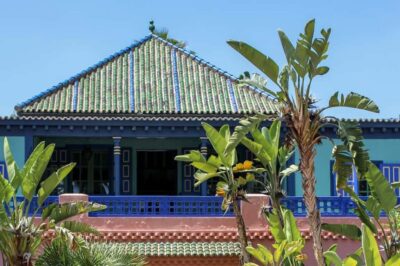

Majorelle Garden, YSL, and Berber Museum Entry
Read our review →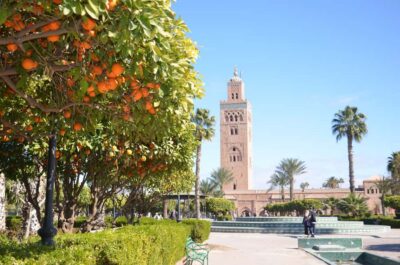
Bahia Palace, Saadian Tombs, Souk and Medina Tour
Read our review →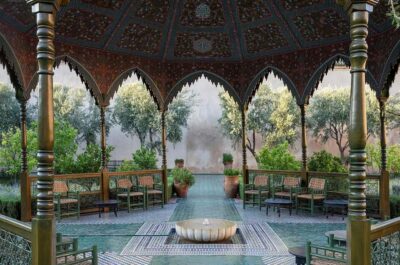
Ben Youssef, Secret Garden, & Souks Walking Tour
Read our review →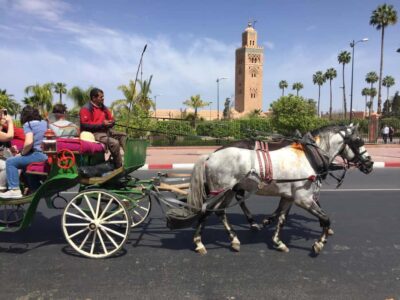
Bahia Palace, Saadian Tombs, & Koutoubia Mosque
Read our review →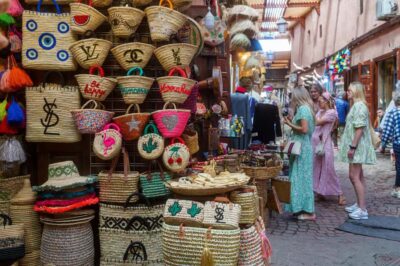
Bahia Palace, Madrasa Ben Youssef and Medina Tour
Read our review →
Madrassa Ben Youssef, Secret Garden & Medina Tour
Read our review →
Private Transfer – Marrakech Menara airport (RAK)
Read our review →Browse the lists this tour appears in