Reviewed · TOURS IN TUNISIA
Private Tour to Kairouan, El Jem & Monastir from Tunis_hammamet
Kairouan’s ancient mosque, El Jem’s enormous Roman amphitheater, and Monastir’s sea-facing fortress make this one of Tunisia’s strongest history day trips. You get three very different places in one long outing, with a private air-conditioned vehicle and a guide focused on your group.
I like the excellent mix of Roman, Islamic, and coastal history, and I like that entrance fees are included rather than collected at every gate. Guides including Yaya, Bilal, Ahmed, and Kimos have been praised for clear explanations and thoughtful service. The tradeoff is simple: this is a full day with plenty of road time, and lunch is up to you.
Key points at a glance
- Three major sights in one day: See Kairouan, El Jem, and Monastir without arranging separate transport.
- Kairouan’s Great Mosque: Explore one of the oldest major Islamic buildings in the Maghreb, with its huge courtyard, carved doors, and marble columns.
- El Jem’s 30,000-seat amphitheater: Walk through the arena and underground areas of one of North Africa’s most striking Roman monuments.
- Private transport and guide: Your group travels in an air-conditioned vehicle, with pickup offered from your hotel.
- Useful guide flexibility: Guides such as Chaouki and Belir have adjusted the day to suit timing, interests, and unexpected site closures.
- A long but efficient day: The advertised duration is about 8 to 10 hours, and the sites are spread across a wide area.
Why this Tunisian history day trip works
This tour connects three places that tell very different chapters of Tunisia’s past. Kairouan brings early Islamic architecture and religious importance. El Jem shows the wealth of Roman Africa through its huge arena. Monastir adds a fortified coastal setting, with the Ribat looking toward the sea.
I like that the route gives you more than a single famous monument. You are not spending the whole day in one museum or old town. Instead, you get a broad look at Tunisia, from sacred buildings and traditional crafts to Roman engineering and medieval defense.
The tour is listed from Tunis, with pickup also offered from Hammamet. It is a private activity, so only your group is meant to participate. That matters on a packed day. You can ask for more explanation at a site, take a little longer with photographs, or keep moving if you have had enough of one stop.
The day is not leisurely. The three main destinations form a wide route, and you will spend a fair amount of time in the vehicle. Still, that road time is the price of seeing Kairouan, El Jem, and Monastir together. If your schedule in Tunisia is short, this is an efficient way to reach places that can be awkward to combine by public transport.
A few more things to do in Africa worth a look
- Cairo: Pyramids & Great Sphinx Private Tour with Camel Ride
★ 4.9 · 6,335 reviews - Cairo 8 Hour Private Tour of Pyramids, Egyptian Museum and Bazaar
★ 5.0 · 2,931 reviews - Private ViP all-inclusive Giza Pyramids,Sphinx,Inside Pyramid
★ 5.0 · 2,448 reviews
Kairouan’s Great Mosque and its enormous courtyard
The day begins with Kairouan, Tunisia’s fourth holy city in Islam and its spiritual center. The Great Mosque is the main reason to come. Founded in 670, it is one of the oldest religious buildings in the Muslim West.
Allow about 40 minutes here. The first thing you notice is the fortress-like exterior and the powerful square minaret. Inside, the courtyard opens on an impressive scale, surrounded by arcades. A sundial sits within the courtyard, adding a practical touch to a place that can otherwise feel grand and formal.
The prayer hall contains rows of marble columns and high carved cedar doors. Your guide can help you read the building as more than a collection of old stones. Its layout, heavy walls, and restrained decoration reflect the importance of prayer, protection, and order in early Islamic architecture.
I would give this stop your full attention, even though the scheduled visit is fairly short. The Great Mosque is the cultural anchor of the entire excursion. El Jem may be more immediately dramatic, but Kairouan gives the day its spiritual and architectural depth.
Dress and behave respectfully at this religious monument. The tour includes admission, but the information provided does not specify every visitor rule or whether all prayer areas are open at every moment. Your guide can explain what is appropriate on the day.
Kairouan’s medina, pastries, and carpet craft
After the mosque, you have about 30 minutes in Kairouan’s medina. This is a short visit, so think of it as a first look rather than a long shopping session.
The old quarter is described as one of Tunisia’s best-preserved and most authentic medinas. You can walk through the souks, look at local crafts, and try makroud, the date-filled pastry associated with Kairouan. The pastry is one of the easiest ways to connect the sightseeing with everyday local life.
Carpet making is also part of the stop. This can be interesting if you want to understand a major Tunisian craft, but it is also where you should stay alert. One serious complaint described a visitor being taken to a carpet shop presented as an official government store, followed by a dispute over the authenticity of a purchase.
That does not mean every carpet stop is improper, but it does mean you should never feel pressured to buy. If you are interested in carpets, ask direct questions about origin, materials, certification, return terms, and who operates the shop. Treat a sales visit as optional. You can enjoy the medina, taste a pastry, and leave without purchasing anything.
The short 30-minute schedule also limits browsing time. If shopping is your main goal, this tour is not designed around it. If you want a quick look at Kairouan’s old quarter between major monuments, it fits well.
Aghlabid Basins and Kairouan’s water system
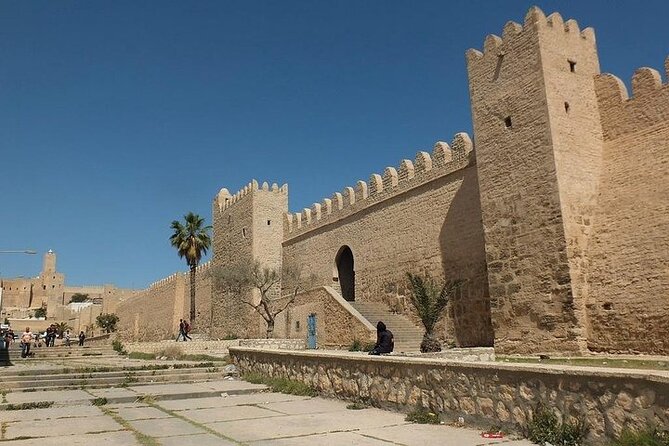
The Aghlabid Basins receive about 20 minutes. They sit outside Kairouan’s medina and date from the second half of the ninth century. These large reservoirs formed part of an ambitious water system and are presented as among the most important hydraulic works in the history of the Muslim world.
This is a quieter stop than the mosque. You will not get the same architectural detail or enclosed atmosphere, but the basins help explain how Kairouan functioned as a major city in a dry region. Water storage was not a minor convenience. It supported urban life, travelers, religious institutions, and political power.
Twenty minutes is enough to see the site and hear the basic story. If you enjoy engineering or urban history, you may wish the schedule allowed longer. For most people, the stop works as a compact piece of context before the route continues toward El Jem.
Same base, a different sort of day:
- Marrakech: Agafay Desert Sunset, Camel Ride, and Dinner Show
★ 4.6 · 35,119 reviews - From Marrakech: Ouzoud Waterfalls Guided Hike and Boat Trip
★ 4.7 · 33,630 reviews - Marrakech: Agafay Desert Quad & Camel Rides with Dinner Show
★ 4.8 · 27,382 reviews - Marrakech: Agafay Desert Quad Biking Tour with Dinner-Show
★ 4.8 · 16,569 reviews
El Jem’s Roman amphitheater and underground passages
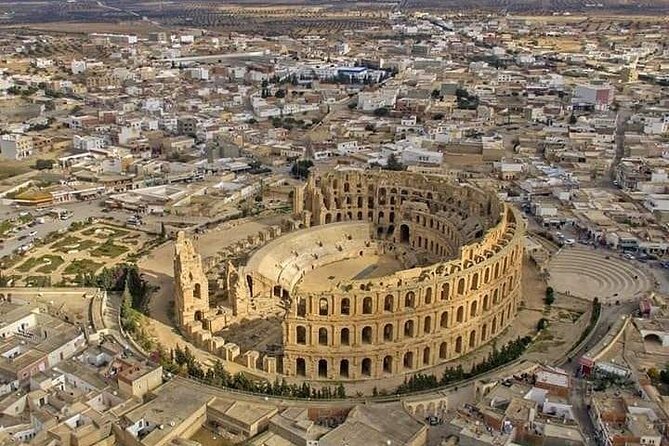
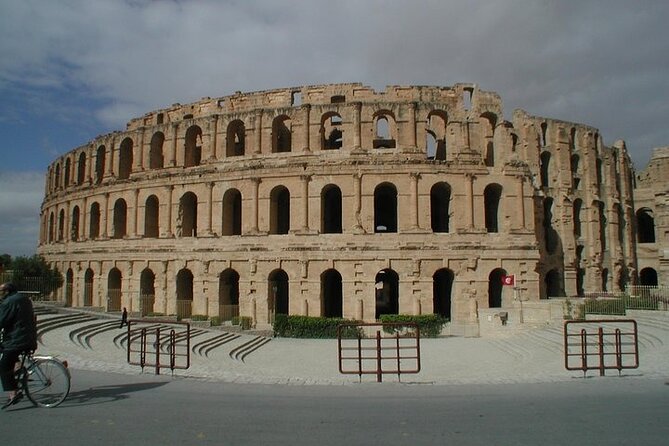
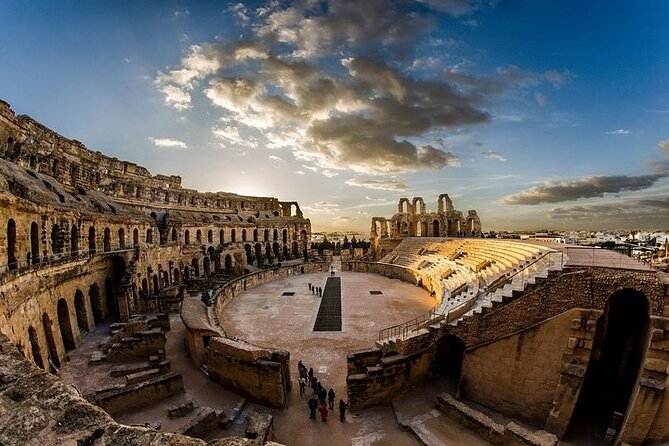
El Jem is likely to be the visual high point of the day. The ancient city was called Thysdrus and became one of the most prosperous places in Roman Africa. Its amphitheater could hold about 30,000 spectators, placing it among the largest in the Roman world, after Rome and Capua.
The planned visit lasts around 40 minutes. That is enough to enter the arena, look up at the tiers, and explore the underground structures beneath the floor. The underground areas are a major reason this amphitheater feels different from a quick photo stop. They show how the building operated behind the public spectacle.
The scale is hard to grasp from outside. Once inside, you can see how the arena dominated the city and how much money and labor went into its construction. The site was classified as a World Heritage Site in 1972, and it deserves more than a hurried glance.
Several guides have been singled out for making El Jem especially memorable. Ahmed was praised for combining the monument’s history with useful insight into Tunisian culture. Caulios was described as giving strong explanations of the arena and its underground structures. The quality of the guide matters here because the bare walls do not explain themselves.
Forty minutes is useful but not generous. If you like ancient architecture, ask your guide how the time will be divided before entering. You may want to spend less time on a surface overview and more time in the arena and underground passages.
Monastir’s Ribat and its sea views
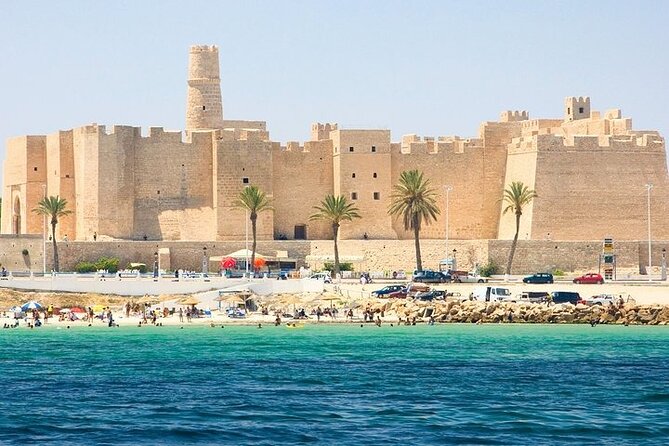
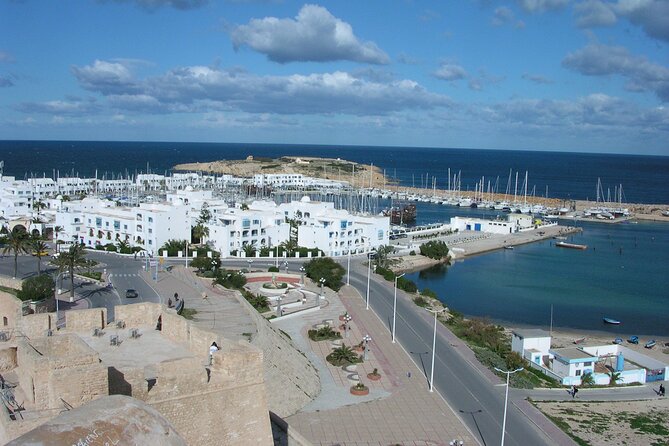
The final major stop is the Ribat of Monastir, an early Islamic fortress founded in 796. It was built as part of the defensive network along the Maghreb coast and later changed through medieval renovations.
The building began as a quadrilateral complex with four main sections around two courtyards. Small cells once housed warrior monks who combined military duties with prayer and contemplation. The Ribat also contains prayer rooms and displays connected with medieval worship and craft.
The most physical part of the visit is the climb to the watchtower. About 100 spiral steps lead upward. From the top, you can look across Monastir and toward the sea. The climb is worthwhile, but it is not suitable for everyone, so pace yourself and ask your guide about the route if stairs are a concern.
The Ribat gives the tour a strong finish because it combines architecture, military history, religion, and views. After the enclosed spaces of Kairouan and El Jem, the open coastal outlook changes the mood.
The planned visit lasts about 40 minutes. That should allow time for the main rooms and the tower, though you may need to move steadily. One guide, Belir, was praised for making sure the group saw as much as possible when one location closed earlier than expected. That kind of flexibility is useful on a day with several fixed stops.
What the private format adds
Private touring is the main practical advantage here. You travel with your own group rather than joining a large coach party, and the vehicle is air-conditioned. Pickup is offered, and most people can take part according to the supplied information.
The guide and driver share the workload. A careful driver matters because the route includes long stretches between sites. One positive account specifically praised both the driver’s care and the guide’s flexibility. Another described the day as easier than planning and executing the route alone.
The guide roster can vary. Names associated with strong experiences include Yaya, Kimos, Bilal, Ahmed, Chaouki, Belir, and Bilel. Do not assume a specific person unless your booking confirms it. What you should expect is a certified professional guide, though the operator has also explained that at least one guide involved in a complaint was an independent guide registered with Tunisia’s national tourism office rather than a direct employee.
The private format can also make the cost better for a small group. At about $98.48 per person, the value depends on how many people share the booking. The price includes the air-conditioned vehicle, guide, and admission to the Great Mosque, Kairouan medina, El Jem amphitheater, Monastir Ribat, and Aghlabid Basins. Lunch is not included.
For three major destinations and five included admissions, that is a reasonable price if you value convenience and commentary. It is less attractive if you only want to see El Jem, or if you are comfortable arranging your own transport and visiting without a guide.
Timing, lunch, and what to bring
Plan for an 8 to 10-hour outing. The exact length can shift because the sites are spread out, pickup locations vary, and the group may spend more or less time at each stop.
Lunch is not included, so plan ahead with your guide. The information provided does not name a fixed restaurant or meal arrangement. Ask early in the day when and where you will stop, especially if you have dietary needs or prefer a set meal budget.
Wear practical shoes. Kairouan’s medina, the amphitheater, and the Ribat all involve walking over historic surfaces, and the Ribat includes a spiral stair climb. Bring water, sun protection, and a phone or camera. The air-conditioned vehicle helps during the long drives, but you will still spend time outdoors.
The tour requires good weather. If poor weather cancels the outing, you are offered a different date or a full refund. You can also cancel for a full refund up to 24 hours before the start time. Changes made inside that 24-hour window are not accepted.
Who should book this tour
I would choose this trip if you want a broad, history-focused day without managing the driving yourself. It suits couples, families, and small groups staying in Tunis or Hammamet who want to reach Kairouan, El Jem, and Monastir in one outing.
It is especially useful for first-time visitors who want a guide to explain the difference between early Islamic architecture, Roman public buildings, and medieval coastal defenses. The strongest guide accounts describe warm service, clear explanations, punctual pickup, and a willingness to adjust the day.
I would hesitate if you dislike long drives, want slow time in each medina, or prefer to spend a full day at one site. I would also be cautious about buying carpets unless you have done your own research and feel comfortable refusing a sales pitch.
Should you book it?
Book this tour if your priority is efficient sightseeing with private transport and a guide. Kairouan and El Jem alone justify the effort, while Monastir adds a different setting and a memorable view from the Ribat tower.
Before booking, confirm your pickup point, ask how lunch will work, and clarify who will guide your group. If you accept the long day and keep shopping optional, this is a strong way to see three of central Tunisia’s most important historic places.
FAQ
How long does the tour last?
The experience lasts approximately 8 to 10 hours.
Is hotel pickup offered?
Yes. Pickup is offered, and the tour information refers to departures from Tunis and Hammamet.
Is this a private tour?
Yes. It is described as a private activity, with only your group participating. Group discounts are also offered.
What is included in the price?
The price includes GST, a certified professional tourist guide, an air-conditioned vehicle, and admission to the Great Mosque of Kairouan, Kairouan medina, El Jem amphitheater, Monastir Ribat, and Aghlabid Basins.
Is lunch included?
No. Lunch is not included.
Can most people participate?
Yes. The supplied information says most people can participate. The Ribat also has about 100 spiral steps leading to its watchtower, which may be important if stairs are difficult for you.
What happens if I need to cancel?
You can cancel at least 24 hours before the start time for a full refund. Cancellations or changes made less than 24 hours before the start time are not accepted. If poor weather causes the tour to be canceled, you are offered another date or a full refund.
Just added in Africa
- Cairo Private Day Tours: Discover Islamic and Coptic Cairo★ 4.5 · 231 reviews
- Islamic Cairo Walking Tour: Khan el Khalili, Al-Azhar Mosque★ 5.0 · 96 reviews
- Grand Egyptian Museum, Grand staircase, New Galleries & lunch★ 5.0 · 174 reviews
- Cairo Food Tours & adventures +30 Tastings★ 5.0 · 146 reviews
- Visiting Egyptian Museum Citadel and Old market of Khan Khalili★ 4.5 · 141 reviews
- Allinclusive Half DayPrivateTour Giza PyramidsSphinx Ticke Lunch★ 5.0 · 195 reviews
- Private Guided tour to Giza Pyramids,Sphinx Camel Ride and Lunch★ 5.0 · 79 reviews
- Hurghada: Full-Day Diving Tour with Lunch & Two Dive Sites★ 5.0 · 82 reviews
Tours in Tunisia, compared.
VIP Tour: Tunis Medina/Bardo, Sidi Bou Said, Carthage |PICKUP ALL
Read our review →
Fun VIP Tour: El Jem, Kairouan, Monastir/Sousse (PICKUP ALL City)
Read our review →