
Reviewed · EGYPT · TOURS IN CAIRO
Giza pyramids, Sphinx, and the big museumum
The most interesting feature here is the story of pyramid development. Instead of seeing only Giza, you follow the royal tomb from Djoser’s six-step monument at Saqqara to Snefru’s Bent and Red pyramids, then to the great pyramids of Giza. That gives the monuments a clear sequence rather than leaving you with a pile of enormous stones and no sense of how the design changed.
I like the private vehicle and hotel pickup, which matter greatly on an eight-hour Cairo day. I also like the chance to enter the Red Pyramid and possibly one of the Giza pyramids, since the narrow passages and stark chambers add a physical side to the history. The main drawback is that entrance fees and tipping are extra, and the schedule is ambitious. You will spend a lot of the day moving between sites, and the museum portion is described broadly rather than with a precise gallery plan.
Key points to know before booking
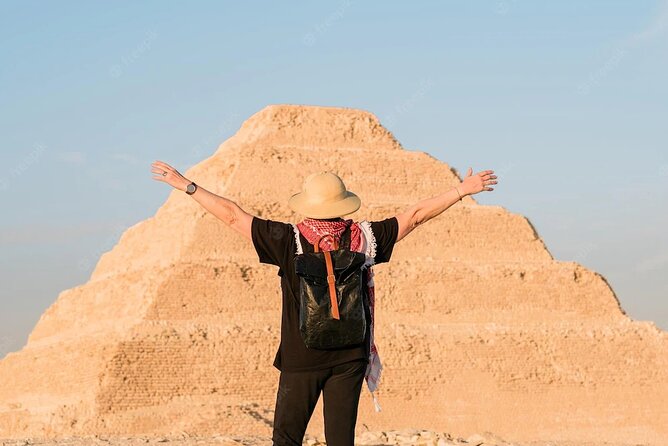
- Five major archaeological stops: The route covers Giza, the Sphinx, Djoser’s Step Pyramid, the Bent Pyramid, and the Red Pyramid.
- Private touring: Only your group participates, with private transportation, a guide, bottled water, and hotel pickup and drop-off.
- A useful historical sequence: You see how royal tomb design changed from steps to a bent profile to a true pyramid.
- A full eight-hour day: The schedule includes long drives between Cairo-area sites and roughly five hours of listed sightseeing time.
- Museum collections included in the plan: Expect coffins, jewelry, gold, statues, masks, ancient objects, and stories about Egyptian gods.
- Extra costs matter: Admission tickets are not included, and neither is tipping.
Why this route makes sense
Many Cairo excursions focus almost entirely on Giza. This one takes a wider view. You begin with early pyramid design, then follow the changes that led to the smooth-sided monuments associated with Egypt’s great royal age.
That makes the day especially useful if you want more than a photo in front of Khufu’s pyramid. The guide’s central theme is the meaning of the pyramid shape, including its connection to Ra, the sun god and creator figure. Some of the explanation is presented through ancient religious ideas rather than modern engineering alone, so you get both the spiritual purpose and the practical development of the tomb.
The tour is listed at $40 per person. For a private eight-hour outing with transport, a guide, hotel pickup and drop-off, and bottled water, that is a reasonable starting price. You must budget extra for site admissions and tipping, though. The final cost depends on which interiors and museum areas you enter.
The private format also gives you more control than a large coach tour. You are not sharing the vehicle with strangers, and the operator can focus its explanations on your group. The trade-off is that the route is packed. A day that includes Saqqara, Dahshur, Giza, the Sphinx, and a major museum is not a slow archaeological study.
Other ways to see the pyramids from Cairo:
- Cairo: Pyramids & Great Sphinx Private Tour with Camel Ride
★ 4.9 · 6,335 reviews - Tour to Giza Pyramids and The Egyptian Museum
★ 5.0 · 6,016 reviews - VIP All inclusive Best of the best Giza Pyramids,Sakkara,Memphis
★ 5.0 · 3,164 reviews
Djoser’s Step Pyramid and the first design leap
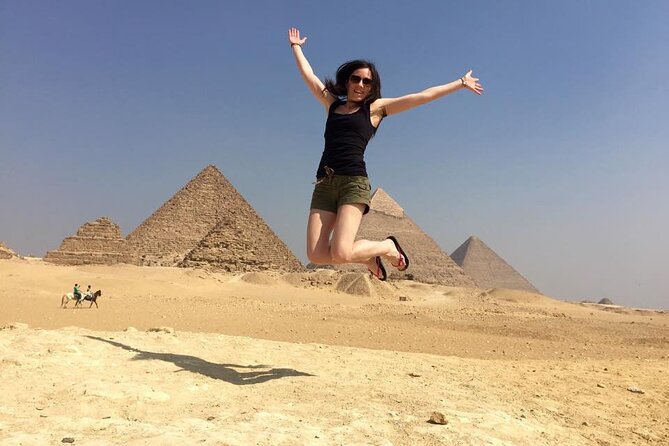
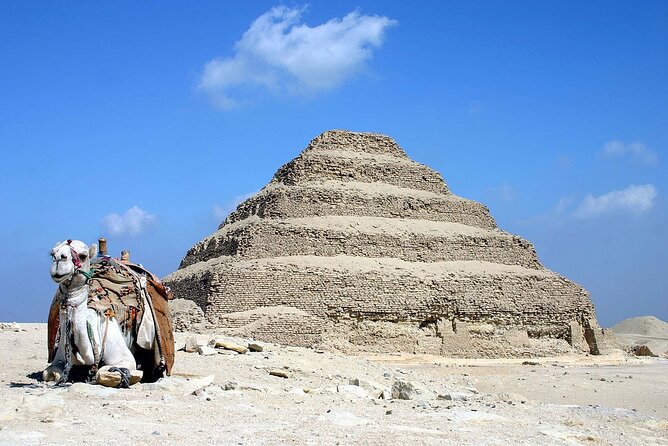
The first major stop is the Pyramid of Djoser at Saqqara, described here as the earliest pyramid in the sequence and dating to about 3000 BC. Its six rising levels are very different from the smooth faces at Giza, and that difference gives the guide a natural way to explain the change in royal tomb design.
The tour presents Imhotep as the designer who moved the royal tomb toward pyramid form. The Step Pyramid did not yet have the clean triangular profile later kings wanted, but it marks a huge shift from earlier tomb styles.
This stop is valuable because it changes your expectations. At Giza, you see finished perfection. At Saqqara, you see an experiment in progress. You can understand why the later pyramids are not isolated wonders, but part of a long effort to create a stable monument that could carry a king toward Ra and protect his mummy.
About two hours are allocated to this part of the day, though the listed admission is not included in the tour price. The description does not specify every structure you will enter, so ask your guide what access is available on your date.
The Bent Pyramid and a visible engineering problem
The Bent Pyramid at Dahshur is one of the most revealing stops because its shape records a change made during construction. The lower section rises at a steep angle, then the upper section becomes more shallow. The result looks as if the pyramid suddenly changed its mind.
The explanation given on the tour is that the builders began with a large angle and changed it partway up. That makes the monument easy to read from the outside. You do not need an advanced background in archaeology to see that the builders were testing what the structure could support.
The pyramid was built for Snefru, father of Khufu, also known as Cheops. The tour places it between Djoser’s Step Pyramid and Snefru’s Red Pyramid, making it an important link in the story.
You may also enter the royal tomb here. The interior is empty, and the passages can feel more important than the chamber itself. This is not a polished museum visit. It is a direct look at an old stone structure, with the physical effort of moving through it forming part of the experience.
The listed visit lasts about an hour, and the admission fee is extra. If you dislike confined passages or steep interior routes, take that into account before paying for entry.
The Red Pyramid and the move to a true profile
The Red Pyramid is presented as the first successful true pyramid in Snefru’s building program. Its sides keep a regular angle from base to summit, unlike the Bent Pyramid. That makes it the clearest stop for understanding how Egyptian builders arrived at the shape later perfected at Giza.
The name comes from the reddish tone of its stone. The tour includes the chance to go inside, which is one of the day’s more active experiences. The description points to a cold interior and an adventure through the pyramid, though you should expect the main appeal to be the passage itself and the sense of being inside the monument, not decoration.
This is where the route’s historical structure pays off. Djoser gives you the stepped form. The Bent Pyramid shows an adjustment during construction. The Red Pyramid presents the regular shape that became the model for the next generation.
The stop is scheduled for about an hour, with admission extra. Wear practical clothing and be ready for physical effort, since the interior route is part of the attraction. The supplied information does not state the exact access conditions on the day, so confirm the current entry arrangements with the guide.
Same base, a different sort of day:
- From Cairo: Pyramids of Giza, Sphinx, Saqqara & Memphis Tour
★ 4.7 · 3,110 reviews - Cairo 8 Hour Private Tour of Pyramids, Egyptian Museum and Bazaar
★ 5.0 · 2,931 reviews - Cairo: Pyramids, Sakkara & Memphis Tour with Lunch
★ 4.6 · 2,493 reviews - Private ViP all-inclusive Giza Pyramids,Sphinx,Inside Pyramid
★ 5.0 · 2,448 reviews
Giza and the Great Pyramid of Khufu
At Giza, the story reaches its best-known stage. The tour focuses on Khufu’s pyramid, describing it as the improved form of the design developed under his father, Snefru. The guide explains the pyramid as a symbol connected to Ra, with the shape representing power, stability, and protection for the dead king.
You will hear the traditional figure of about one million stones and two million tons of material. The tour also raises the question of how stone was transported along the Nile, including the idea of material coming from Luxor to Giza. That gives the discussion a practical angle, even though the exact building process remains one of the great subjects of ancient Egyptian study.
The pyramid itself is the visual heavyweight of the day. You can look at the huge blocks and understand why a good guide matters. Without context, the monument is simply massive. With a clear explanation, you can connect its scale to royal power, religious belief, labor, transport, and the desire to preserve the king forever.
The Giza visit is scheduled for about two hours, with admission listed separately. The plan does not promise entry to the Great Pyramid, but the wider tour description refers to entering the pyramid of Keops as one of the possible memorable parts of the day. Ask exactly which interior tickets are included in your booking and which you must purchase.
The Sphinx and the guard of the plateau
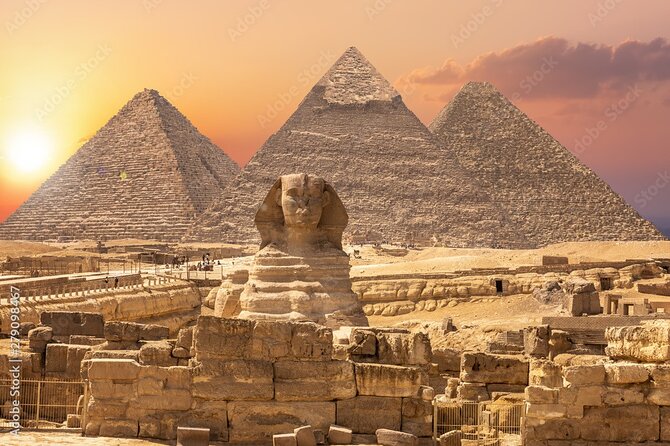
The Sphinx takes about an hour. Its lion body and human face are explained as a combination of strength and intelligence, with the face identified with King Khafre. The tour also describes the monument as cut from a single mass of stone, a detail that helps you appreciate the scale of the carving.
The missing nose and damaged beard lead into a short history of the Sphinx’s exposure to sand and later damage. You also see the nearby temple area associated with Khafre and the sun worship connected to Ra, including the cycle of sunset and rebirth.
There is a playful element here too. The guide points out a wishing well where you can throw a small coin. Treat it as a light moment in an otherwise serious archaeological visit, and keep your expectations modest.
The Sphinx is one of the best places for photographs, especially because the human and animal forms are easy to read from a distance. The guide may also help with pictures. Morsi is specifically associated with this tour and is described as especially good at taking photos, so if he is assigned to your group, ask him to help before you leave the viewing area.
Admission is extra. The site can feel crowded and exposed, and the day’s heat may make the one-hour visit feel longer than it looks on paper.
The major museum collection
The final museum portion is described as a visit to the big museum, with coffins, jewelry, gold, statues, masks, ancient objects, and material connected to different Egyptian gods. The exact museum name, gallery sequence, and ticket arrangement are not specified, so confirm those details before the tour begins.
What makes this addition worthwhile is the contrast with the outdoor monuments. At Giza and Dahshur, you see architecture at a huge scale. In the museum, you can focus on objects made for individual lives, rituals, burial, and worship.
Coffins and masks help explain how Egyptians imagined the afterlife. Jewelry and gold show the wealth placed around royalty. Statues give you a closer look at faces and bodies that are difficult to study from a distance at a pyramid complex.
Do not expect to see every museum room in a short final stop. The itinerary is already full, and a museum needs time if you want to read labels and compare objects. Think of this as a useful introduction, especially if you plan to return for a longer visit.
Timing, transport, and the real cost
The scheduled start is 8:00 am, and the total duration is about eight hours. Hotel pickup and drop-off are included, along with private transportation and bottled water. Those details make a real difference in Cairo, where moving between separate archaeological areas can consume much of your day.
The listed stop times add up to roughly seven hours, before allowing for driving, tickets, meals, traffic, and any photo stops. That is why you should treat the schedule as a full-day outline rather than a promise that every minute will run exactly on time.
The tour is private, but group discounts are offered. Most people can participate, and service animals are allowed according to the supplied conditions. The information does not provide detailed mobility guidance, so anyone with concerns about steep pyramid passages or uneven archaeological ground should ask the operator before booking.
Free cancellation is available if you cancel at least 24 hours before the local start time. Changes made inside that window are not accepted, and a full refund is available if the operator cancels because its minimum number is not met.
Who should book this Cairo day
I would choose this tour if you want the main pyramid story in one organized day and prefer a private car to public transport. It suits first-time Cairo visitors, families who want a guide to connect the sites, and anyone curious about how the pyramids changed over time.
It also fits people who want a mix of outdoor monuments and museum objects. The route gives you the Step Pyramid, Bent Pyramid, Red Pyramid, Giza, the Sphinx, and a large collection of ancient pieces rather than repeating the same type of site.
I would hesitate if you want a slow day at Giza, a carefully timed museum study, or a tour with every admission already covered. You should also be comfortable with a long schedule and possible interior pyramid passages.
The experience has a 5 out of 5 rating from 225 reviews, with 100 percent recommendation shown in the supplied information. That positive record should not hide the practical issues: one complaint raised concern about repeated booking messages and dissatisfaction with the company, while the operator disputed that account. Most useful praise centers on the guide, driver, organization, photography, and the ability to fit several pyramid areas into one day.
Should you book it?
Book this tour if you want breadth and historical sequence more than a leisurely pace. At $40 per person, the private transport, guide, hotel service, and wide route offer good value before admissions and tips are added.
The strongest reason to choose it is the progression from Djoser to Snefru to Khufu. You leave with a better sense of how the royal tomb evolved, not just a single iconic photograph. Confirm the museum name, interior pyramid tickets, admission costs, and exact pickup details before paying. If those details suit you, this is a practical way to cover Cairo’s major pyramid story in one demanding but rewarding day.
FAQ
How long does the tour last?
The tour lasts approximately eight hours.
What time does the tour start?
The scheduled start time is 8:00 am.
Is hotel pickup included?
Yes. Hotel pickup and drop-off are included.
Is transportation private?
Yes. Private transportation is included, and only your group participates in the activity.
Which pyramid sites are included?
The route includes Djoser’s Step Pyramid, the Bent Pyramid, the Red Pyramid, and the pyramids at Giza.
Is the Sphinx included?
Yes. The Sphinx of Giza is included, although its admission fee is not included in the tour price.
Are entrance fees included in the $40 price?
No. Entrance fees are listed as not included. Tipping is also not included.
Is bottled water provided?
Yes. Bottled water is included.
Can I cancel for a full refund?
Yes, if you cancel at least 24 hours before the experience start time. Cancellations made less than 24 hours in advance are not refunded.
Just added in Cairo
- Cairo Private Day Tours: Discover Islamic and Coptic Cairo★ 4.5 · 231 reviews
- Islamic Cairo Walking Tour: Khan el Khalili, Al-Azhar Mosque★ 5.0 · 96 reviews
- Grand Egyptian Museum, Grand staircase, New Galleries & lunch★ 5.0 · 174 reviews
- Cairo Food Tours & adventures +30 Tastings★ 5.0 · 146 reviews
- Visiting Egyptian Museum Citadel and Old market of Khan Khalili★ 4.5 · 141 reviews
- Allinclusive Half DayPrivateTour Giza PyramidsSphinx Ticke Lunch★ 5.0 · 195 reviews
- Private Guided tour to Giza Pyramids,Sphinx Camel Ride and Lunch★ 5.0 · 79 reviews
- Hurghada: Full-Day Diving Tour with Lunch & Two Dive Sites★ 5.0 · 82 reviews
Giza Pyramids & Sphinx Tours, compared.

Pyramids & Great Sphinx Private Tour with Camel Ride
Read our review →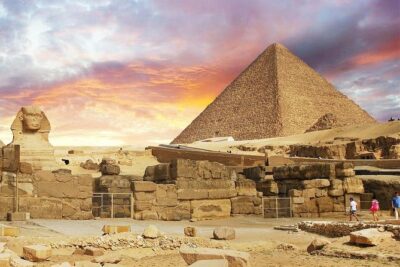
Tour to Giza Pyramids and The Egyptian Museum
Read our review →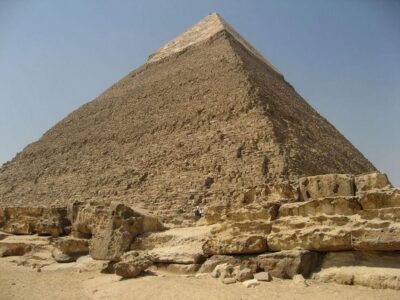
VIP All inclusive Best of the best Giza Pyramids,Sakkara,Memphis
Read our review →
Pyramids of Giza, Sphinx, Saqqara & Memphis Tour
Read our review →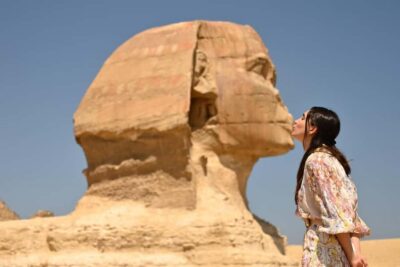
Half-Day Tour to Pyramids of Giza and the Sphinx
Read our review →
Private ViP all-inclusive Giza Pyramids,Sphinx,Inside Pyramid
Read our review →
Grand Egyptian Museum, Pyramids, Sphinx Tour & Lunch
Read our review →
Cairo Pyramids, Sphinx & Egyptian Museum Day Trip
Read our review →Browse the lists this tour appears in